AI-generated illustrative learning scene of a child using a laptop; not a testimonial.

NSW Selective Practice Tests

For students typically preparing in Year 6, explore free sample questions with answers and build familiarity through complete online practice and review.

Try nine Selective sample questions

No account is needed. Read each question, choose an answer, then open the explanation to compare your reasoning.

These short, original examples introduce methods in each subject. They are independent practice, not official questions or a full-length test.

Reading

Question 1: Evaluating viewpoints

After the school library added a quiet reading corner, lunchtime borrowing rose during a two-week trial. The principal called the rise proof that the corner had worked. The librarian was more cautious: those weeks had also been unusually cold, keeping more students indoors. 'Let's keep the corner,' she said, 'and compare borrowing during some warmer weeks before we decide how much difference it makes.'

Which statement best describes the librarian's view?

  1. The trial has proved that the corner caused the rise in borrowing.
  2. The corner should be removed because the weather affected the trial.
  3. The corner is worth keeping while more evidence is gathered about its effect.
  4. Borrowing figures cannot provide any useful evidence about the corner.
Show answer and explanation for Reading question 1: Evaluating viewpoints

Answer: C. The corner is worth keeping while more evidence is gathered about its effect.

Separate the two viewpoints. The principal treats the increase as proof; the librarian notices a competing explanation: cold weather brought more students indoors.

Her words support both parts of C: keep the corner for now, and gather comparison evidence before judging its effect. She neither rejects the corner nor accepts the trial as proof of its impact.

Why the other options do not work
  • A. This is the principal's claim. The librarian identifies the cold weather as another possible explanation and wants a comparison.
  • B. The librarian explicitly says, 'Let's keep the corner.' Being cautious about the evidence is not a request to remove it.
  • D. She proposes comparing borrowing figures in warmer weeks, so she considers them potentially useful rather than useless.
Explore evidence and viewpoint in the Selective Reading guide

Question 2: Distinguishing observation and inference

Each morning, a magpie lands on the same fence just before the sprinklers start. When the water begins, it flies to a nearby tree. Ari says the bird must dislike getting wet. Mei points out that the sprinklers also make a sudden clicking sound and suggests watching what happens when the sound occurs without water.

What is the main purpose of Mei's suggestion?

  1. To show that the magpie never visits the fence at other times.
  2. To test whether the sound could explain the bird's departure.
  3. To prove that the bird enjoys getting wet.
  4. To show that Ari observed the bird leaving incorrectly.
Show answer and explanation for Reading question 2: Distinguishing observation and inference

Answer: B. To test whether the sound could explain the bird's departure.

Ari infers that water causes the departure. Mei identifies the sound as another possible cause and proposes observing the sound without water.

That comparison could provide evidence about the sound's role; it would not by itself prove what the bird likes or establish its behaviour at all other times.

Why the other options do not work
  • A. The proposed observation tests a possible reason for leaving; it cannot establish that the bird never visits at other times.
  • C. The proposed observation does not establish enjoyment, and Mei makes no such claim.
  • D. Mei questions the explanation for the departure, not the observation that it left.
Explore evidence and viewpoint in the Selective Reading guide

Question 3: Figurative language in context

As the deadline approached, the clock seemed to sprint. Lila reread the opening paragraph, crossed out a sentence and finally put down her pen. The minute hand had barely moved, but her thoughts had raced through a dozen possibilities.

What does 'the clock seemed to sprint' mainly convey?

  1. The clock was physically moving faster than normal.
  2. Lila felt pressure as the deadline drew near.
  3. Lila had finished with plenty of time to spare.
  4. The clock stopped while Lila was writing.
Show answer and explanation for Reading question 3: Figurative language in context

Answer: B. Lila felt pressure as the deadline drew near.

A clock cannot literally sprint. The phrase presents Lila's feeling that time is rushing as the deadline approaches.

The nearly stationary minute hand contrasts actual elapsed time with her racing thoughts, reinforcing her sense of pressure.

Why the other options do not work
  • A. The later reference to the minute hand barely moving shows that the clock's actual speed is not the point.
  • C. The approaching deadline and racing thoughts suggest pressure, not evidence of ample spare time.
  • D. The minute hand barely moved, but the passage does not say it stopped.
Explore evidence and viewpoint in the Selective Reading guide

Mathematical Reasoning

Question 1: Changing ratios

A box contains only red and blue counters, in the ratio 3 red to 5 blue. Four red counters are removed and four blue counters are added. The ratio is now 1 red to 3 blue. How many counters were in the box originally?

  1. 16
  2. 24
  3. 32
  4. 40
Show answer and explanation for Mathematical Reasoning question 1: Changing ratios

Answer: C. 32

The total number of counters stays the same: 4 are removed and 4 are added. Originally, red counters make up 3 out of 8 equal parts of that total. Afterwards, they make up 1 out of 4 equal parts, or 2 out of 8.

The fall from 3 eighths to 2 eighths is 1 eighth of the unchanged total. That fall is 4 red counters, so the original total is 8 × 4 = 32.

Check: 32 counters in the original 3:5 ratio means 12 red and 20 blue. After the change, there are 8 red and 24 blue. Dividing both by 8 gives the required 1:3 ratio.

Why the other options do not work
  • A. Initially there would be 6 red and 10 blue. The change gives 2 red and 14 blue, a ratio of 1:7 rather than 1:3.
  • B. Initially there would be 9 red and 15 blue. The change gives 5 red and 19 blue, not the required ratio of 1:3.
  • D. Initially there would be 15 red and 25 blue. The change gives 11 red and 29 blue. For a ratio of 1:3, 11 red would need 33 blue.
Explore relationships and checking in the Selective Maths guide

Question 2: Weighted averages

A group of 8 students has an average score of 70. Four more students join, and the average for all 12 students becomes 75. What is the average score of the four who joined?

  1. 77.5
  2. 80
  3. 85
  4. 90
Show answer and explanation for Mathematical Reasoning question 2: Weighted averages

Answer: C. 85

The original total is 8 × 70 = 560. The new total is 12 × 75 = 900.

The four students therefore contributed 900 − 560 = 340 points. Their average is 340 ÷ 4 = 85.

Why the other options do not work
  • A. The increase in the overall average cannot simply be added halfway to 75; the groups have different sizes.
  • B. An average of 80 for the four gives a combined total of 560 + 320 = 880, short of the required 900.
  • D. An average of 90 for the four gives a total of 920, which would make the combined average more than 75.
Explore relationships and checking in the Selective Maths guide

Question 3: Simultaneous relationships

Three adult tickets and two child tickets cost $44 in total. One adult ticket and two child tickets cost $24 in total. How much does one child ticket cost?

  1. $5
  2. $7
  3. $10
  4. $14
Show answer and explanation for Mathematical Reasoning question 3: Simultaneous relationships

Answer: B. $7

Subtract the second purchase from the first: two adult tickets cost $44 − $24 = $20, so one adult ticket costs $10.

In the second purchase, two child tickets cost $24 − $10 = $14. Each child ticket costs $7. Check: 3 × $10 + 2 × $7 = $44.

Why the other options do not work
  • A. The adult ticket costs $10, leaving $14 for two child tickets, not $10.
  • C. Ten dollars is the adult ticket price; two child tickets together cost $14.
  • D. Fourteen dollars is the cost of two child tickets, not one.
Explore relationships and checking in the Selective Maths guide

Thinking Skills

Question 1: Necessary conditions

Every team that submits a plan before Friday receives feedback. Only teams that receive feedback may revise their plan. Team K revised its plan, following these rules. Which statement must be true?

  1. Team K submitted its plan before Friday.
  2. Team K received feedback.
  3. Every team that received feedback revised its plan.
  4. No team submitting on Friday or later received feedback.
Show answer and explanation for Thinking Skills question 1: Necessary conditions

Answer: B. Team K received feedback.

Read 'only teams that receive feedback may revise' as a requirement: a team following the rules must have received feedback if it revised. Team K did revise, so it must have received feedback.

The first rule works in one direction: submitting before Friday guarantees feedback. It does not say every team receiving feedback submitted before Friday, so it cannot prove K's submission date.

Why the other options do not work
  • A. Submitting early guarantees feedback, but the rules do not say that it is the only way to receive feedback. Receiving feedback does not establish when K submitted.
  • C. Feedback permits revision; it does not require a team to revise. A team could receive feedback and leave its plan unchanged.
  • D. The first rule guarantees feedback for early submissions. It does not forbid feedback for later submissions.
Explore necessary conditions in the Selective Thinking Skills guide

Question 2: Constraint deduction

Four workshops P, Q, R and S run one at a time, each in a different slot from 1 to 4. P is before Q. R is immediately after P. S is before P. Which workshop must be in slot 3?

  1. P
  2. Q
  3. R
  4. S
Show answer and explanation for Thinking Skills question 2: Constraint deduction

Answer: C. R

R follows P immediately. Q is after P and cannot fit between P and R, so Q follows the pair. S must precede P.

The only order is S, P, R, Q. It satisfies every rule and puts R in slot 3.

Why the other options do not work
  • A. S must precede P, while both R and Q must follow it, so P cannot be third.
  • B. The forced order is S, P, R, Q, placing Q fourth.
  • D. S must precede P and therefore cannot be third when R and Q also follow P.
Explore necessary conditions in the Selective Thinking Skills guide

Question 3: Evaluating evidence

A school wants to learn whether students in all year groups would use a new lunchtime activity. Which approach would provide the most useful evidence for that question?

  1. Ask only students already attending a similar activity.
  2. Ask students from each year group, including those who do and do not attend similar activities.
  3. Ask one teacher to predict every student's preference.
  4. Count the equipment already stored at school.
Show answer and explanation for Thinking Skills question 3: Evaluating evidence

Answer: B. Ask students from each year group, including those who do and do not attend similar activities.

The question concerns students across all year groups, so seeking views from each group is relevant. Including students with different activity habits reduces the narrowness of asking existing participants alone.

This approach does not guarantee every response predicts actual use, but it is more informative for the stated question than the other choices.

Why the other options do not work
  • A. These students may be more interested than other students, and their responses may not represent all year groups.
  • C. One teacher's predictions do not directly collect students' views across the year groups.
  • D. Equipment numbers do not show whether students in each year group would use the activity.
Explore necessary conditions in the Selective Thinking Skills guide

Practice and review

SteadyMarks connects the timed student experience with explanation, reflection and a clearer decision for the next session.

Complete timed set

Work through a coherent set instead of an endless stream of unrelated questions.

Focused student mode

A focused online test surface helps the student concentrate on the current question, navigation and timing.

Useful answer review

Objective-question review connects the supported answer to its reasoning, while progress helps identify a manageable next focus.

Parent-readable progress

Use supported skill patterns and recent effort to choose a specific, proportionate next session.

Preparing for NSW Selective

The complete free choice brings the currently supported subject tests together under one family entitlement.

  • Reading
  • Mathematical Reasoning
  • Thinking Skills
  • Writing

Review and next steps

No inflated prediction is needed. A useful result should explain what happened and point to a manageable action.

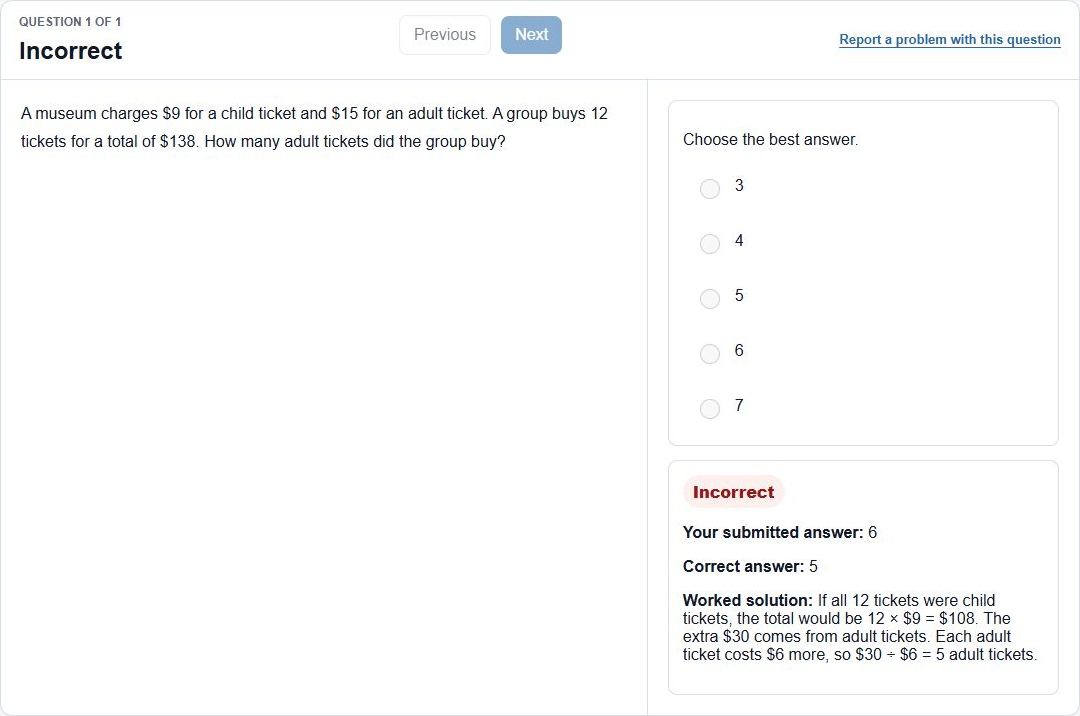
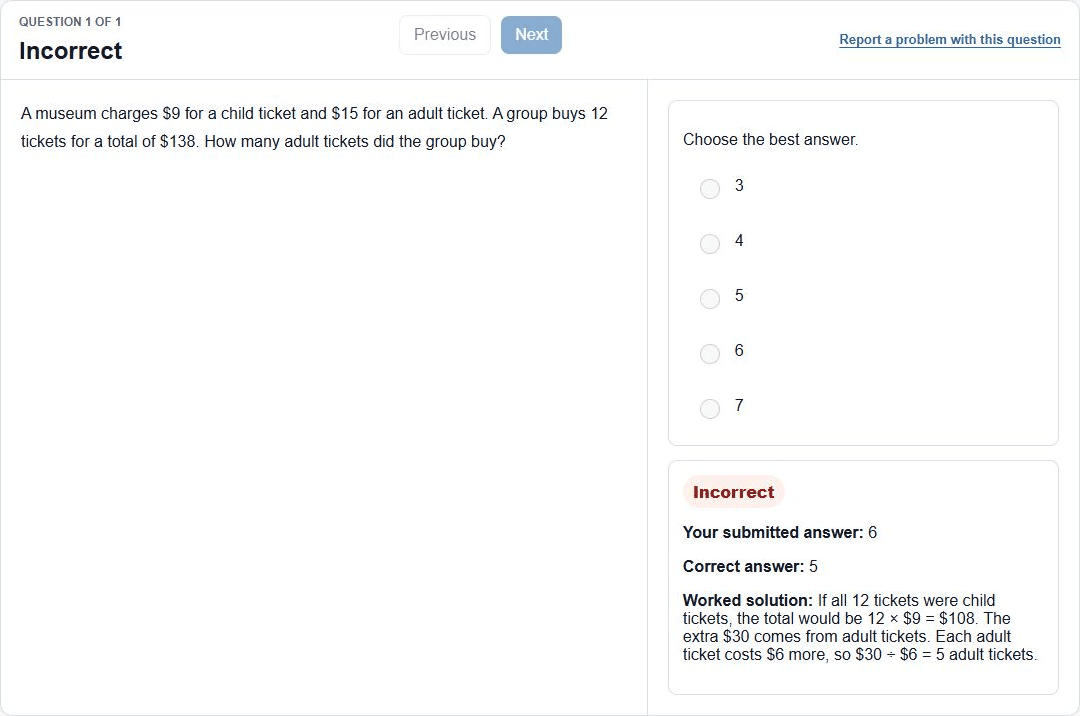
SteadyMarks demonstration answer review screen. No student data.
Demonstration review screen. No student data.View full-size example

Make the next practice decision together

Use supported answer review to understand the reasoning, then choose one manageable skill or practice habit for the next session.

AI-generated illustrative parent and child reviewing learning together; not a testimonial.
AI-generated illustrative learning scene.

Common questions

Is this an official test?

No. SteadyMarks is an independent practice platform. Its tests are not official results, admission predictions or endorsed assessment material.

What does the free choice include?

One family can choose either one complete OC set or one complete Selective set, assigned to one child for 30 days from assignment. It includes the supported timed tests, result and answer-review experience.

Do we need to buy anything?

No purchase is required to claim the free test. Current practice-pack pricing is listed on the Pricing page.

Start practising

Choose the free Selective test, create the family account and assign it to the child who will sit it.

Explore Thinking Skills, Maths and Reading methods in Learning Lab. Lesson access depends on the student's pack.