Begin when the student is ready to think, not just ready to hear the score.
A short break between practice and review can make the conversation more useful. Start by recognising the effort involved and explain that the purpose is to understand the work, not to deliver a second judgement.
Select a manageable sample. Include a few missed questions, one unanswered question if relevant and one difficult question the child answered correctly. The successful example can reveal a strategy worth repeating and prevents review from becoming a catalogue of failures.
Prepare the evidence
- The question and the answer the child selected or wrote.
- The supported answer and explanation, where available.
- Any notes about uncertainty, changed answers or time pressure.
- A simple place to record the pattern and next action.
Use four questions to find the turning point.
- What did you think the question was asking? This checks interpretation before discussing the answer.
- What did you try? Ask for the child’s real approach, even if it was incomplete or based on guessing.
- Where did the approach stop working? Find the missed condition, unsupported inference, wrong operation, omitted step or rushed decision.
- What could you notice or do next time? Turn the finding into a small, reusable instruction.
Example review conversation
Question pattern: a child chose an option supported by one sentence but missed a word that changed the comparison.
Unhelpful conclusion: “Read more carefully.”
Usable next action: “Before checking the options, underline the two things being compared and the word that tells you how to compare them.”
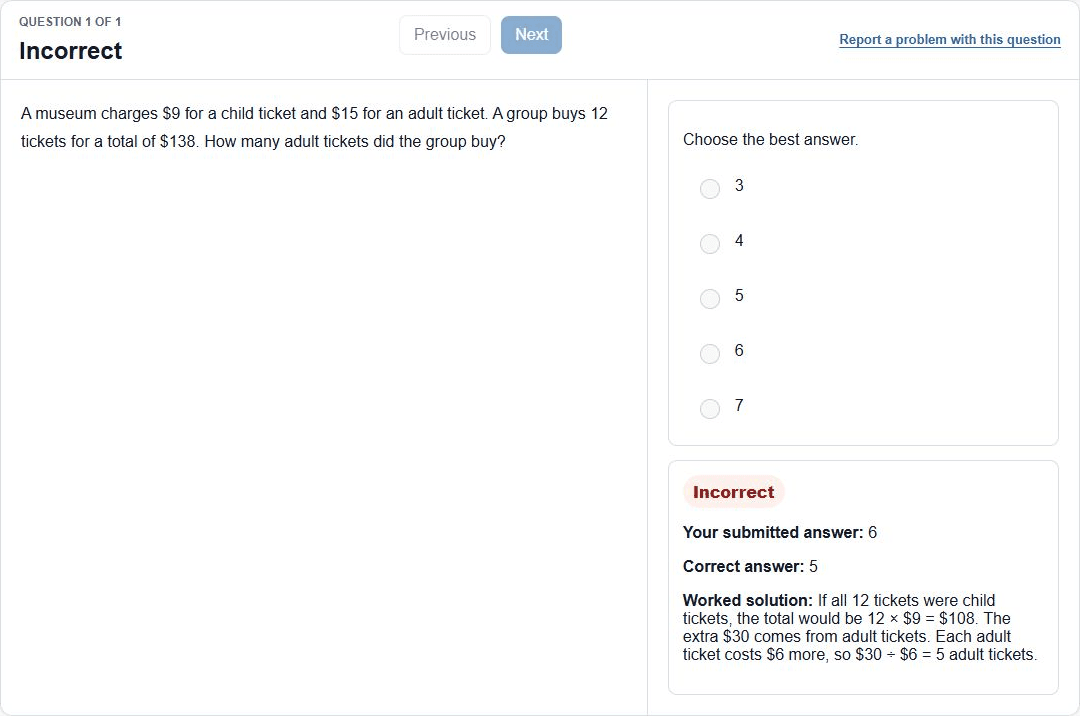
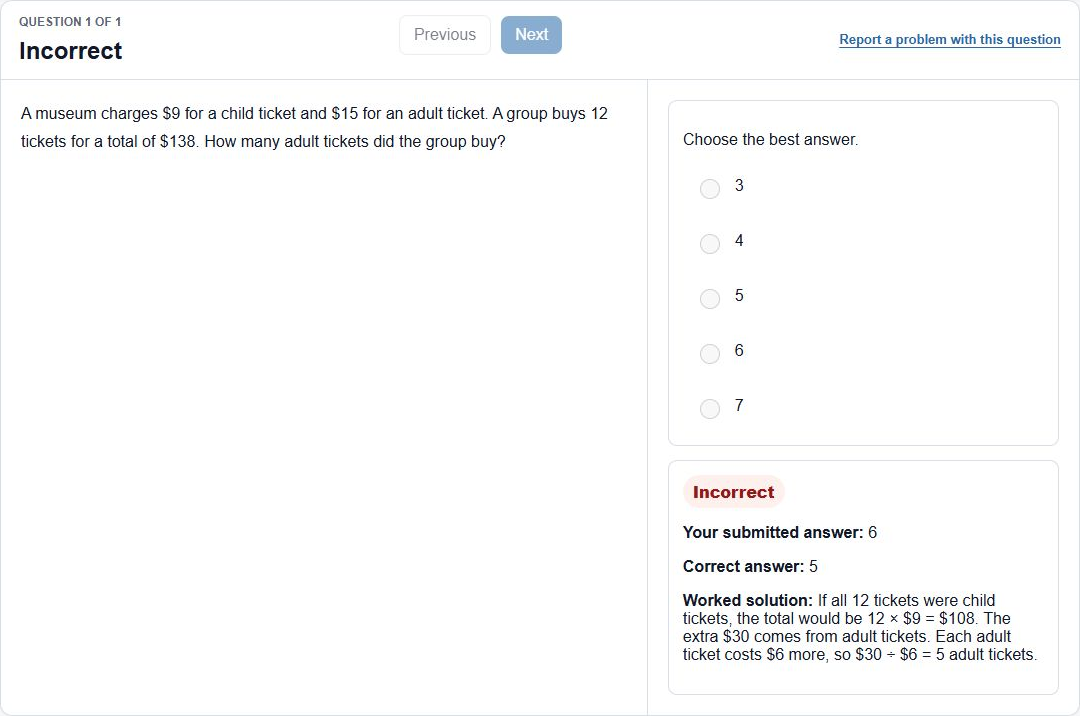
If the child cannot yet explain the original approach, show one step of the supported reasoning and ask what should happen next. The goal is to rebuild understanding, not to force a perfect verbal explanation on demand.
Group mistakes by cause, not by subject label alone.
“Reading mistake” or “maths mistake” is usually too broad to guide the next session. A small set of cause categories helps a family distinguish missing knowledge from a decision made under pressure.
- Interpretation: an important word, condition, relationship or piece of evidence was missed or misunderstood.
- Knowledge or strategy: the student did not yet know a required fact, method or reasoning pattern.
- Execution: the correct approach was chosen, but a step, calculation or answer transfer went wrong.
- Checking: the response was not tested against all conditions or the question that was actually asked.
- Pacing or attention: the decision changed because the student rushed, became stuck, tired or distracted.
- Interface familiarity: navigation, answer selection or on-screen reading affected the response.
Use categories as descriptions of this attempt, not labels for the child. “This answer was rushed” invites a practical change. “You are careless” turns one observable event into an identity claim and gives no clear repair.
Finish with one action that can transfer to a new question.
A useful action begins with a cue the child can notice and a response they can perform. Keep it short enough to remember during independent work.
Cue-and-action examples
- When a problem contains several quantities: label what each number represents before calculating.
- When two options both seem possible: find the exact evidence that rules one of them out.
- When a question is taking too long: make the best supported choice, mark it for review and continue.
- Before submitting an answer: reread the final sentence and check that the response answers that sentence.
Choose one or two actions from a review session. A long correction list is hard to carry into future work. Store other patterns for a later session instead of trying to repair them all immediately.
Repeat to check the method, then use a fresh question to check transfer.
Repeating the original question can confirm that the child now understands the explanation, but it may also test memory of the answer. Once the child can explain the correction, use a different question with the same underlying skill or decision point.
- Repeat now when the method is still unclear and the original example is useful for teaching it.
- Use a fresh example when the child can explain the method and you want to see whether it transfers.
- Move on for now when frustration is rising or a different prerequisite skill must be taught first.
- Recheck later when you want to see whether the action is remembered without an immediate prompt.
Use language that keeps the child in the problem-solving role.
Instead of “Why did you get this wrong?”
Try: “Show me what you noticed first and what you tried next.”
Instead of “You knew this.”
Try: “The method looks familiar. Which step became difficult in this version?”
Instead of “You need to be more careful.”
Try: “What check would have caught this before you moved on?”
Instead of “Your score went backwards.”
Try: “What was different in this paper or in the way you worked today?”
Apply the method in the preparation context that matters.
SteadyMarks study advice reviewed 4 August 2026. No official test-format or policy details are discussed on this page.